Action Plan on Drone and Counter Drone Security
Action Plan on Drone and Counter Drone Security, presented in 11th Febryary by The European Comission, has four goals: enhance Europe’s preparedness and resilience against drone incidents, leverage technologies and 5G networks to better detect drones, reinforce responses to malicious drone activity and strengthen Europe’s defence readiness against drone threats. Recent incidents related to malicious or irresponsible use of drones have exposed growing security challenges for the Union. This Action Plan is the Commission’s response to calls from Member States and the European Parliament for a united approach to combatting threats.
Drones play a significant role in modern economies and societies. Their growing matter in surveillance and reconnaissance has also made them a key component of Europe’s security. The Commission wants to speed up technological development and industrial production ramp-up. EU needs a faster movement from lab to deployment
To achieve it’s four main goals – better preparedness, detection, response and defence readiness – action plan introduces a list of key actions:
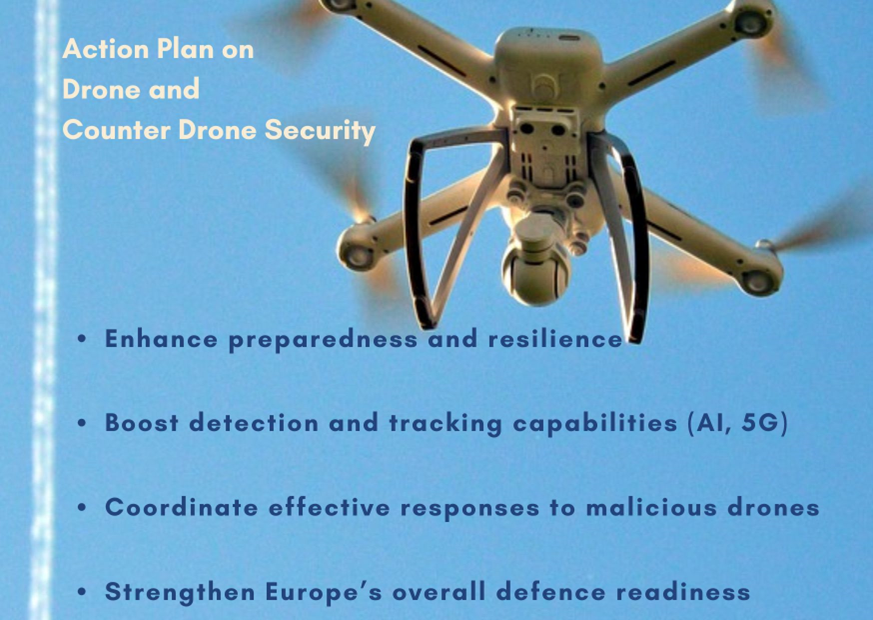
Enhance preparedness and resilience
One of the main goals is to ensure that the EU invests where it really matters, helping to scale up production, foster dialogue with industrial actors, and attract investment. The Drone and Counter-Drone Industry Forum will be launched in the next quarter (Q2) to ease communication. Coordinated civil–military industrial mapping will prioritise technologies and capacities, thereby attracting investment and fostering interoperability. The plan also focuses on strengthening counter-drone testing capacity via the EU Counter-Drone Centre of Excellence (Q1 2027). The plan also focuses on strengthening counter-drone testing capacity via the EU Counter-Drone Centre of Excellence (Q1 2027).
A forthcoming Drone Security Package (due in Q3) will revamp existing civilian drone rules, adapting them to new security realities. It will also introduce coordinated risk assessments for supply chains and establish an ‘EU Trusted Drone’ label for secure equipment (Q4). The label will help to identify secure equipment and enhance the trustworthiness of civil drones placed on the market.
Boost detection and tracking capabilities with help of new technologies
The Commission will continue to support the development of leading technology for drone detection.
Detecting malicious drones relies on a multi-sensor approach that combines several technologies powered by AI software. The action plan promotes the development of integrated air display systems and a potential drone incident platform, as well as the greater use of AI-powered, multi-sensor technologies and 5G networks. This will enable precise, real-time tracking in response to emerging threats, such as drone swarms. To facilitate the rapid deployment and live testing of 5G-based detection systems, the Commission will issue a Call for expressions of interest from Member States and industry partners.
Coordinate effective responses to malicious drones
The Commission will support joint procurement of counter-drone systems and organise annual large-scale EU exercises. Comission also explores the opportunity to build Rapid Counter-drone emergency teams (Q4) to increase solidarity between Member States and mutual assistance against drone threats. Comission also continues equipping Frontex to enhance border surveillance and cross-border coordination.
In line with Apply AI-strategy the AI Gigafactories currently being established with the support of the EU budget should facilitate the development of AI-Powered C2 (command and control) capacities for autonomous assets with the view to deploy sovereign software solutions.
Strenghten Europe’s overall defence readiness
This Action Plan will support and complement Member States ongoing actions on boosting Europe’s military readiness through innovation and industrial cooperation, including securing a supply of critical raw materials. Plans actions are linked to the Defence Readiness 2030 Roadmap too.
The plan will also strengthen cooperation with partners such as the Drone Alliance with Ukraine, support innovation and mass production, and mobilize EU funding instruments. The plan aims to foster a competitive and innovative European drone market. . The Commission will increase its support to develop a stronger drone ecosystem.
Funding
EU funding programs support the technological development, research and innovation of drones and counter-drone capacities through Horizon Europe and the European Defence Fund. The EDF also enables the operation of the EU Defense Innovation System (EUDIS) instrument, which strengthens defense innovation in the European Union. Actors can also get financed by the European Defence Industry Programme (EDIP) and SAFE loans. The Integrated Border Management Fund supports improvements to border surveillance and threat detection, and the European Innovation Council (EIC) Accelerator scheme supports start-ups and scale-ups.
More private financing should be leveraged to support innovation and the ramping up of production. From a European industrial perspective, the commercial airborne drone market segment alone is forecast to be worth around €14.5 billion by 2030, with the potential to exceed €50 billion by 2033. As the EU seeks to avoid high-risk suppliers and strengthen European manufacturers and the drone market, the market will also increase for companies and skilled workers in the Tampere region.
You can read the full action plan here!